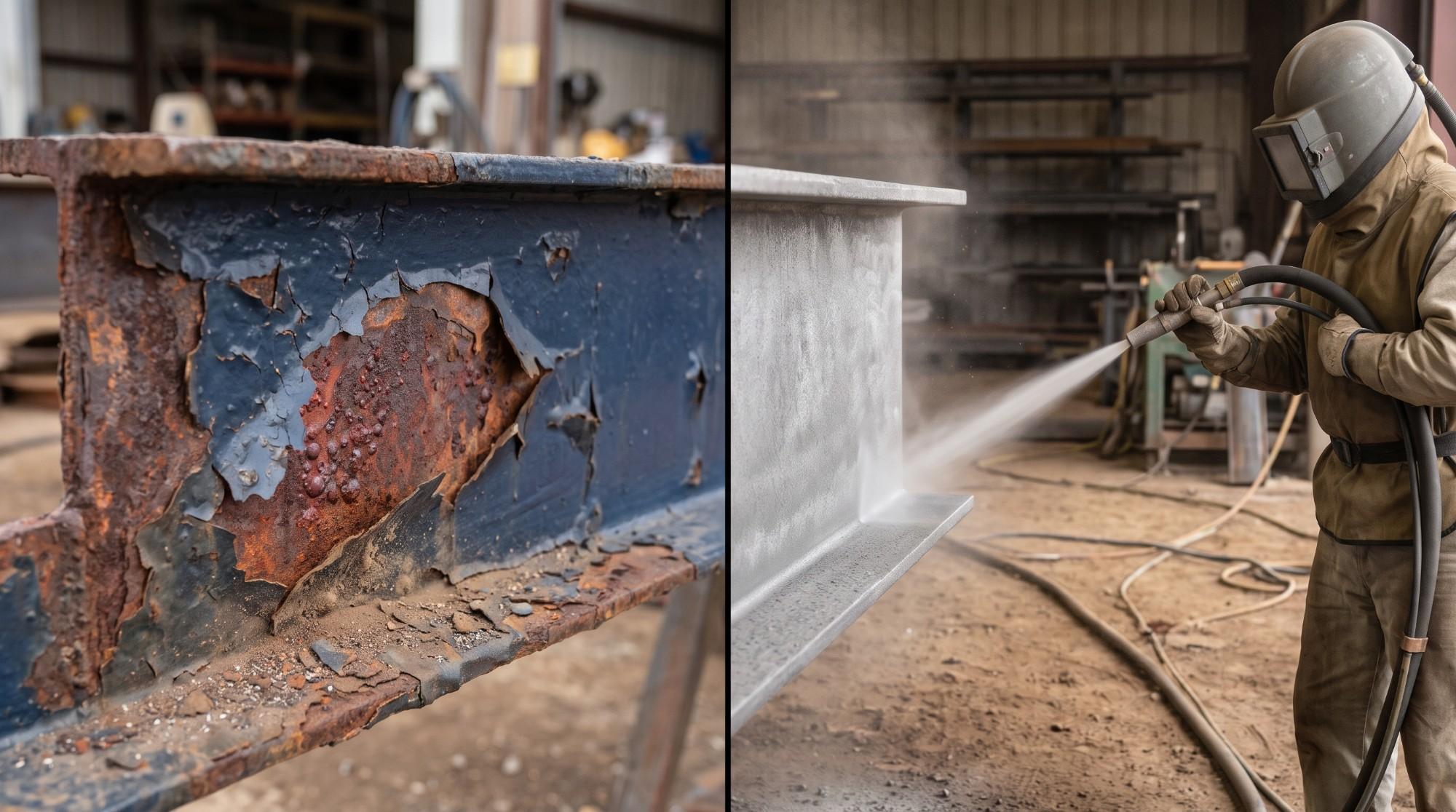
One of the questions our workshop hears most is:
“Can't you just powder coat straight over it? It's only got a bit of surface rust and the old paint is mostly still stuck on.”
Our answer is always the same: we could, but it would fail, and we don't do work that fails.
Powder coating unblasted metal is like laying expensive tiles on loose sand. It doesn't matter how good the powder is; if the surface underneath has no mechanical bond, the coat peels off in sheets at the first knock or temperature swing.
Surface preparation accounts for more than 80% of a coating's long-term durability. Here's why sandblasting isn't optional.
1. Getting rid of mill scale
When steel plate, tubing, angle iron or I-beams are hot-rolled, the red-hot surface reacts with oxygen as it cools and forms a brittle blue-grey oxide crust called mill scale. New steel with mill scale looks clean and ready to coat. It isn't:
- Different expansion rates. Mill scale expands at a very different rate to the steel beneath. A Gauteng gate can reach 45 °C in summer sun and drop to 2 °C on a winter night, so the two layers constantly move against each other.
- Cracking and delamination. That movement micro-fractures the scale. Moisture gets in, the scale flakes off, and it takes the new coating with it.
- Galvanic corrosion. Mill scale is electrochemically more noble than iron. Add rainwater or humidity and you get a tiny battery that speeds up corrosion of the steel underneath.
Sandblasting shatters mill scale instantly, stripping it back to clean raw steel.
2. Creating an anchor profile
Smooth metal is slippery at a microscopic level. Liquid paints use solvents to wet out smooth surfaces, but thermoset powder needs a physical, mechanical grip.
Blasting doesn't just clean, it profiles. Angular garnet or chilled steel grit hitting the surface at over 600 km/h cuts hundreds of thousands of tiny peaks and valleys into every square centimetre. This roughness, the anchor profile, is typically 25–50 microns deep.
In our curing oven the powder becomes a low-viscosity gel that flows into those valleys and wraps around the peaks. As it cross-links and hardens, it's physically locked into the metal, like tree roots gripping rock. It can only come off by deliberate mechanical damage or chemical stripping.
3. Cleanliness grades: why SA 2.5 matters
ISO 8501-1 grades blasting by how clean the surface ends up:
- SA 1 (light blast): only loose rust and scale removed. Not acceptable for powder coating.
- SA 2 (commercial blast): rust and scale removed, but shadows and stains remain on up to a third of the surface.
- SA 2.5 (near-white, our standard): at least 95% of contaminants, scale, oxides and old coatings removed. An even light-grey metallic finish with a crisp anchor pattern.
- SA 3 (white metal): 100% clean white steel. Reserved for offshore, military or chemical-immersion work.
Our blasting team works strictly to SA 2.5, and every part leaving the booth is inspected under bright task lighting before it moves to coating.
4. Beating flash rust
Freshly blasted steel is extremely reactive. With its oxides stripped, it wants to bond with oxygen and moisture. In humid weather, blasted steel on a workshop floor can show a yellow haze of flash rust within two hours, and coating over it compromises adhesion.
Because blasting and coating happen in one facility, our transfer window is short:
- Parts are blasted to SA 2.5.
- Clean, dry high-pressure air blows off all dust.
- Parts are racked and rolled straight into the spray booth.
- Powder goes on and the parts go into the oven before oxidation can start.
Don't skimp on the foundation
Whether you're restoring suspension parts, building industrial skips or fabricating balustrades for an estate in Pretoria East, the rule is the same: your finish is only as good as the preparation underneath.