If you own a home or a manufacturing business in Pretoria, Centurion or Johannesburg, you know the Highveld climate is hard on metal. Summer UV indexes above 11, violent afternoon thunderstorms and winter nights near freezing all take their toll.
Walk through almost any suburb or industrial park in Pretoria East and you'll see steel gates, bakkie canopies and palisade fences with peeling, chalking enamel, often with orange rust bleeding from the welds within 12 to 18 months of painting.
Choosing between liquid spray paint and electrostatic powder coating is the difference between a finish that lasts two decades and one that needs constant repainting.
How each one cures
Wet paint: the porous solvent problem
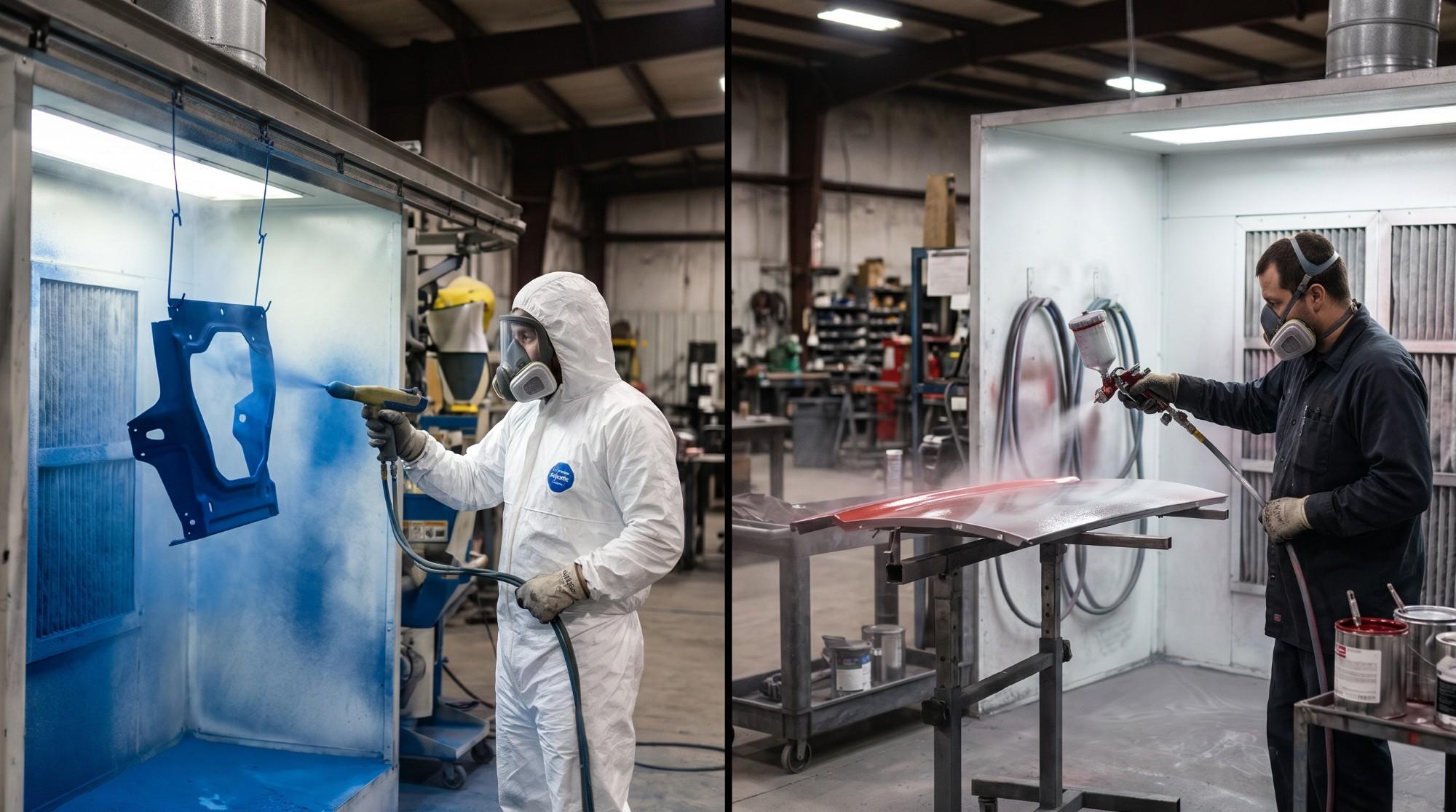
Spray paints, whether acrylic, enamel or polyurethane, suspend pigment and resin in thinners and solvents (VOCs). As the solvents evaporate, they leave a thin film of resin behind.
That's the weakness: evaporating solvent leaves microscopic pores across the whole surface. Under a microscope, cured paint looks like an open sponge.
As the steel expands and contracts in the sun, oxygen and moisture seep through those pores. When moisture reaches the steel it forms rust, and because rust takes up several times the volume of the original steel, it pushes the paint up into bubbles and flakes.
Powder coating: no solvents, one continuous coat
Powder coating has no liquid solvents, no thinners and no VOCs. It is dry, finely ground resin blended with pigments, flow agents and curing agents.
- Electrostatic deposition. The powder passes through a high-voltage gun that gives each particle a negative charge. The part is earthed.
- Wrap-around attraction. Like opposite poles of a magnet, the charged powder is pulled onto the part, with no runs, drips or thin spots on sharp edges or laser-cut detail.
- Thermal cross-linking. In a batch oven at 180–200 °C the powder melts, flows into an unbroken film and undergoes an irreversible chemical reaction.
The result is a continuous, solid plastic shell bonded to the metal, with no solvent pores, pinholes or weak seams.
Head to head
| Criterion | Wet spray paint | Powder coating |
|---|---|---|
| Impact & scratch resistance | Low. Chips from gravel, tools and abrasion. | Excellent. Flexes with the metal without chipping or cracking. |
| Highveld UV stability | Poor. Enamels chalk, yellow and lose gloss in 12–24 months. | Outstanding. Pure polyester resins are made for extreme UV. |
| Coverage on sharp edges | Inconsistent. Surface tension pulls paint off sharp corners. | Even. Powder builds evenly over 90° corners and weld fillets. |
| Corrosion life | 1–3 years before rust creeps under the film. | 10–20+ years over an SA 2.5 blasted profile. |
| Environment & safety | Toxic VOCs, hazardous solvent disposal. | No solvent fumes or VOCs; overspray can be recycled. |
Upfront price vs. lifetime cost
Many property owners and buyers assume spray paint is cheaper. A quick coat of enamel may look cheaper on today's quote, but its total cost of ownership is far higher:
- The wet paint cycle: moisture gets into the welds within 18 months. By year three you're paying to scrape, sand, prime and repaint, and you repeat that every few years. Over 15 years, you can spend up to four times more than a single industrial powder coat.
- Powder coating: done once. Stripped, grit-blasted and baked under proper temperature control at M Du Plessis Vervaardigers, the coat lasts for decades with nothing more than an occasional rinse with soapy water.
The verdict
If your metal lives outdoors in Pretoria or anywhere in Gauteng, spray paint is a temporary cosmetic fix. For lasting corrosion protection that keeps its gloss under the Highveld sun, electrostatic powder coating is the benchmark.